1800 106 107

Western Australia

Compensation payouts in Western Australia

How injury compensation is calculated in Western Australia, what the state thresholds and scales mean for your claim, and a free check of what you may be entitled to.

Updated 25 August 2026 Sources listed below

Check your claim

Step 1 of 4

Free and confidential. The check tells you whether you may have a claim and the time limits that apply. What your claim is worth depends on your injuries and losses; a panel lawyer will assess that in your free consultation.

How Western Australia values an injury

There is no single payout figure for an injury. In Western Australia the amount depends first on which scheme applies, because each sets its own rules for what can be claimed and how pain and suffering is scored.

Road accidents

Pain and suffering is only payable if your injury is assessed above 5% of a most extreme case, and it is capped (around $485,000 from July 2024, indexed). Income loss is capped at three times WA average weekly earnings.

Work injuries

No-fault statutory benefits: income compensation, medical and rehabilitation expenses, and a lump sum for permanent impairment calculated against the General Maximum Amount (indexed each July). A common law damages claim against a negligent employer needs a permanent whole-person impairment of at least 15% and a registered election to retain the right to sue. Court proceedings are subject to the 3-year limit.

Public liability and medical negligence

You must prove the occupier or business breached its duty of care. General damages have a threshold and a cap that are indexed each year. The 3-year limitation period under the Limitation Act 2005 applies, running from when you knew of the injury.

The parts of a payout

  • General damages for pain, suffering and loss of enjoyment of life. This is what the calculator above estimates, and it is the part most affected by state thresholds and scales.
  • Past and future economic loss: lost wages so far, reduced earning capacity for the rest of your working life, and lost superannuation. For serious injuries this is usually the largest component and can run to seven figures.
  • Treatment, care and equipment: past and future medical costs, rehabilitation, aids, home and vehicle modifications, and the value of care from family.

What moves the number

Your age and occupation, because future income loss is calculated to retirement. Whether the injury is permanent and how it scores under the state’s impairment or injury scale. Any contribution you made to the accident, which reduces damages proportionally. And the quality of the medical evidence: a claim settles on what can be proved, not what happened.

Time limits

Report the crash to police, notify ICWA as soon as practicable, and lodge a notice of intention to claim. Court proceedings must start within 3 years of the accident (6 years for children under 15). Work injury claims have their own lodgement step: Report the injury to your employer, get a WorkCover WA certificate of capacity from your doctor, and lodge the claim form with the employer. The insurer has a set time to accept or dispute.
Statutory caps and scales, Western Australia

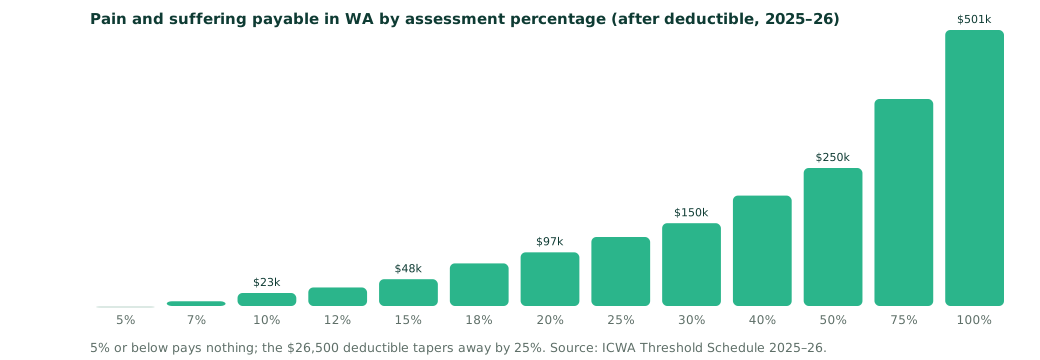
Western Australia does not publish injury-by-injury dollar values the way Queensland does; instead, both of its schemes publish the conversion machinery. For WA motor claims, ICWA publishes the exact schedule: pain and suffering is assessed as a percentage of a most extreme case, each percentage has a fixed dollar value, assessments of 5% or less pay nothing, and a deductible tapers away above $76,500. Negligence claims outside the CTP scheme use the same threshold-and-cap mechanism under the Civil Liability Act 2002 (WA), with amounts indexed separately. For work injuries, the no-fault permanent impairment lump sum is a percentage of the indexed General Maximum Amount, $284,448 for 2026-27, and a 15% whole person impairment opens the separate common law damages claim, which is where the larger settlements come from.

Chart of WA motor accident pain and suffering payable at each percentage of a most extreme case for 2025-26, from nil at 5 percent to $501,000 at 100 percent
AmountCurrent figureYear
Maximum pain and suffering, motor vehicle claims (Amount A)$501,0002025-26
Deductible below which nothing is payable (Amount B)$26,5002025-26
Assessment at 10% of a most extreme case$50,100 gross, $23,600 after deductible2025-26
Assessment at 25% — deductible no longer applies$125,2502025-26
Assessment at 50%$250,5002025-26
Workers compensation: General Maximum Amount$284,4482026-27
Workers compensation: permanent impairment lump sumyour assessed WPI percentage applied against the General Maximum Amount schedule2026-27
Workers compensation: common law gateway15% WPI or more, with a registered electioncurrent

ICWA schedule: percentage of a most extreme case to dollars (2025-26)

AssessmentGrossPayable after deductible
5%$25,050Nil
7%$35,070$8,570
10%$50,100$23,600
12%$60,120$33,620
15%$75,150$48,650
18%$90,180$77,360
20%$100,200$97,400
25%$125,250$125,250
30%$150,300$150,300
40%$200,400$200,400
50%$250,500$250,500
60%$300,600$300,600
75%$375,750$375,750
100%$501,000$501,000

Source: ICWA Threshold Schedule 2025-26. A new schedule issues each financial year; injuries are assessed under the schedule in force when the injury arose.

Figures are the statutory maximums and thresholds published in the sources listed at the foot of this page; indexed amounts change each year and the figure that applies is the one in force when the injury arose. What an individual claim is worth within these limits depends on the medical evidence.

Claims in Western Australia by type

Other states: NSW VIC QLD SA TAS ACT NT

Sources

Free claim check

Find out in minutes if you can claim

Free, confidential, and no pressure to go ahead. Time limits apply to every type of claim, so it is worth checking early.